
WhatsApp
+918650929590


Drive Distance: 246 km
Drive Time: 7-8 hrs
Altitude: 1,205 ft/367 m at Rishikesh to 6,214 ft/1,894 m at Joshimath
Highlights: Scenic drive through Devprayag, Rudraprayag, Karnaprayag, and Nandaprayag
Leave Rishikesh early in the morning; you can hire a cab or take a UTC bus to reach Joshimath directly. You will travel via National Highway 7, passing through beautiful destinations in Uttarakhand. The first stop will be Devprayag, where the Bhagirathi River meets the Alaknanda River. Next, you will arrive at Rudraprayag, the meeting point of the Mandakini River and the Alaknanda River. Further, you will drive through Karnaprayag (Alaknanda and Pindar Rivers meet) and Nanadaprayag (confluence of the Alaknanda and Nandakini Rivers).
Journeying through these sacred stops, you will pass through Hailang, finally reaching Joshimath by evening. You can explore the market here to purchase any trekking essentials and withdraw cash, as it is the last point where an ATM is available. You will be served a warm dinner at the guest house, where you will be spending the night.
Drive Distance & Time: Joshimath to Govindghat (15.2 km, 33 min); Govindghat to Poolna (5 km)
Trek Distance & Time: Poolna to Ghangaria (9-10 km, 5-6 hrs)
Altitude Gain: 6,214 ft/1,894 m at Joshimath to 10,167 ft/ 3,099 m at Ghangaria
Highlight/s: Trek through the dense alpine forest with several waterfalls and river streams
We will start with an early morning drive from Joshimath to reach Govindghat via Badrinath Road on NH7. Upon reaching, visit the Gurudwara Sahib Sri Gobind Ghat, where you can relax and relish a warm meal served in langar. Here, you will also find the confluence of the Pushpawati River with the Alaknanda River. There is a car parking space from where an iron bridge takes you towards the Poolna Village.
From here, you can get a shared taxi to travel via a narrow 5 km road to reach Poolna. Upon reaching, you can find small food stalls where you can get refreshments and also an information centre where you can get your registration done.
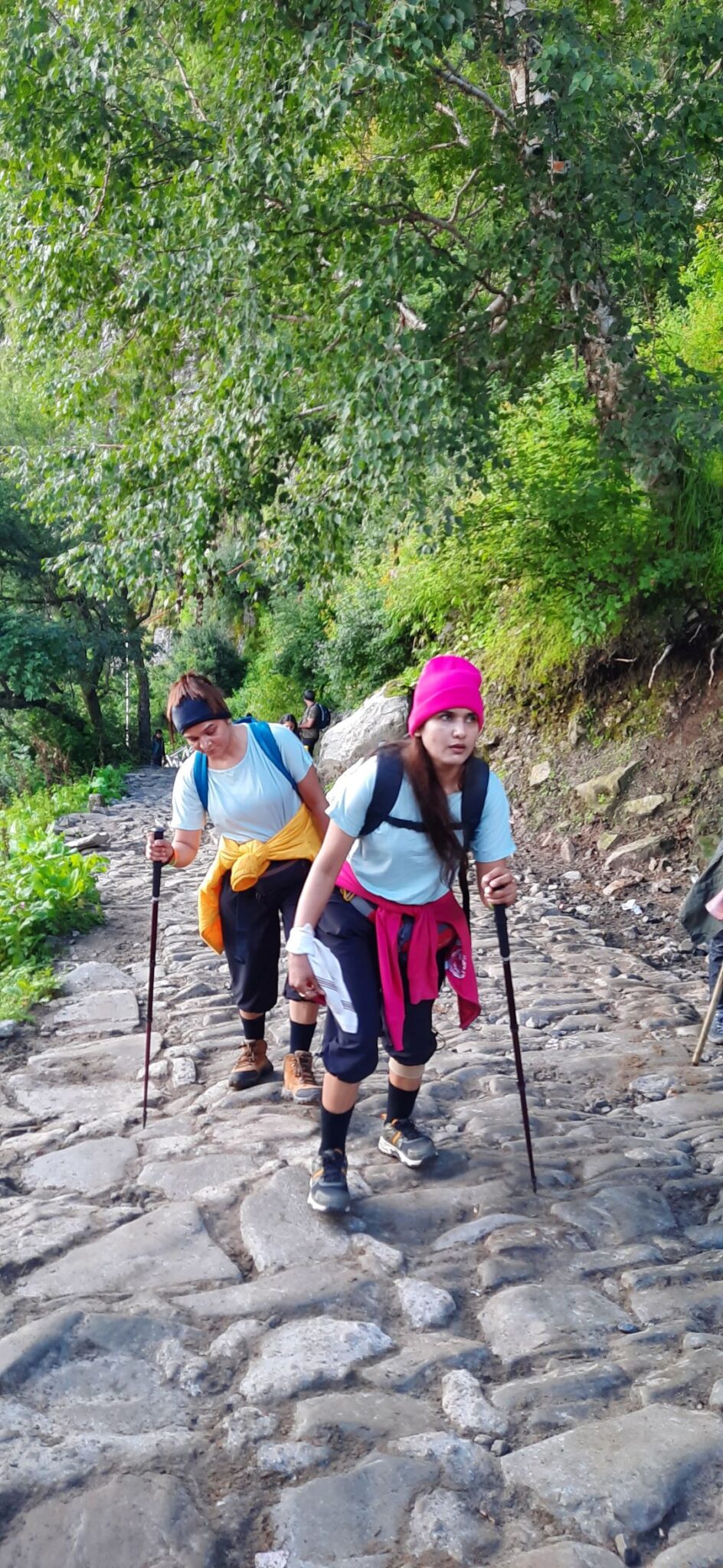
The trail to Ghangaria, the base camp of the Valley of Flowers Trek, starts from here. The path is well marked, and you can also hire mules from Poolna to reach here. On this 5-6 hour trek, you will encounter a big waterfall and lush Deodar Forest trails. It starts with a steep ascent in the village, and further, a 2 km descent will take you to Jungle Chatti. Here, you can pause and fill your bottles at one of the food stalls.
Hiking 2-2.5 km further, you will arrive at Bhyundar Village, where you will get the stunning views of Hathi Parbat. A trail from here diverts towards the Kagbhusandi trek. Cross the stream of the Laxman Ganga River on your trail to continue your hike. A final steep climb will take you to Ghangaria Village. Here, you will find a GMVN guest house and many home stays.
End your evening with a delicious warm meal. Have a restful sleep to recharge for the next day’s exciting trek.
Trek Distance: 8 km, 7 hrs
Altitude Gain: 10,167 ft/ 3,099 m at Ghangaria to 10,498 ft/3,200 m at Valley of Flowers
Highlight/s: Witness the flowering Himalayan paradise, featuring expansive alpine meadows, Pushpawati River, and big waterfalls.
Start your day early, ideally at dawn, so that you reach the Valley of Flowers by afternoon and have ample time to explore its beautiful landscape. Ghangharia has many small dhabas that offer parathas and tea for breakfast. You can also have a meal at the langar, which is served by the Gurudwara in the village. We advise you to pack a nutritious lunch for the hike today and carry at least 2L of water, as you will not find any shops inside the national park.
The slope in the beginning is almost flat, running parallel to the fast-flowing Pushpawati River. Within 1.5 km of the Ghangaria market, you will arrive at the Valley of Flowers National Park checkpost/gate. Here you will get your permit checked (entry opens from 7 am). This marks the formal entry point into the protected area of the valley.
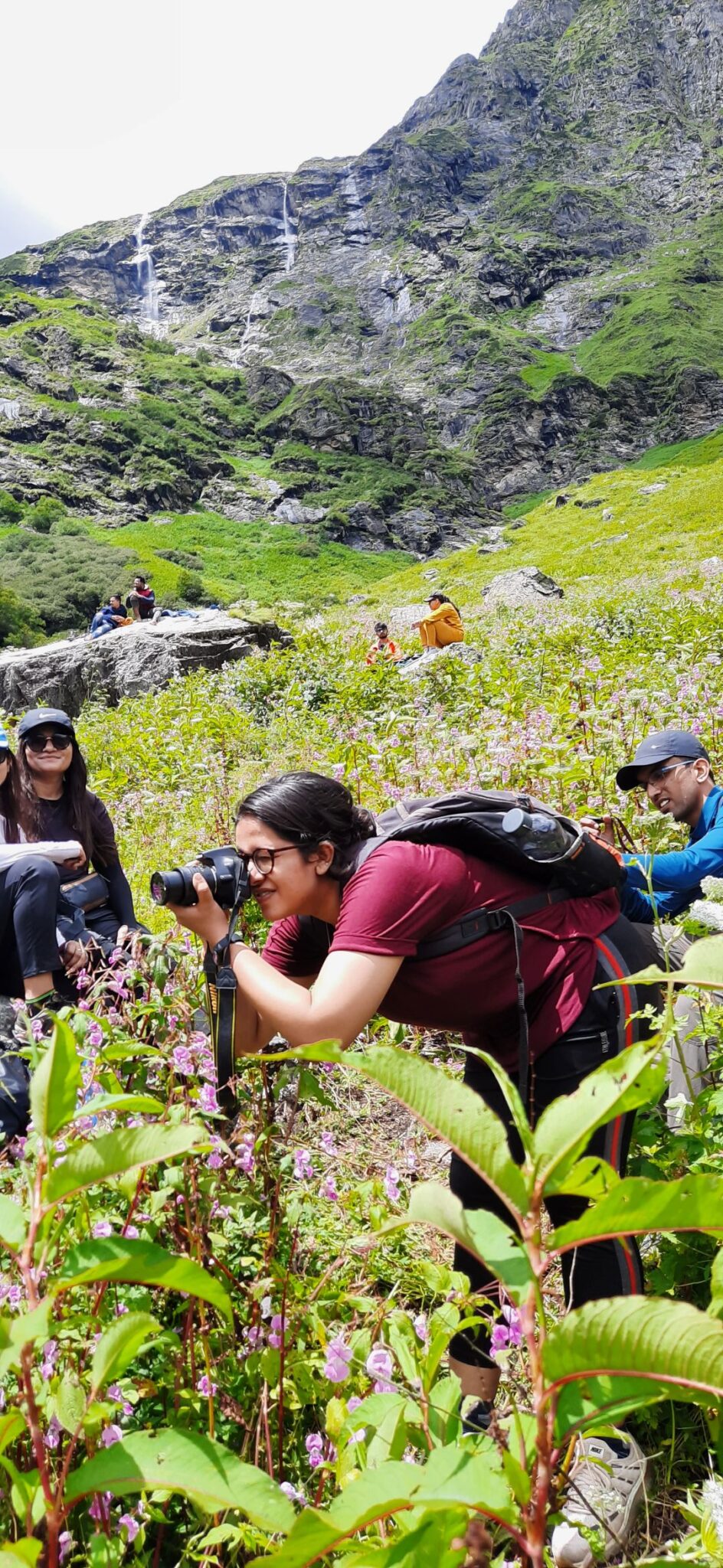
After hiking for 200 m on a rocky trail, you will cross a bridge that stands over the stream of the Pushpawati River. Here, you will encounter the first big waterfall of your scenic trail. Keep following the designated trails that wind through the dense Deodar forest. The views keep getting better as you hike up with the valley opening further and colourful wild flowers gleaming in the sunlight.
On your way, you will find many viewpoints, giving you breathtaking views of the entire Bhyundar Valley, carpeted with flowers. The weather inside the valley remains unpredictable, no matter what season you are travelling in. To protect yourself from rainfall, you will find many caves here that will provide you with shade.
Gradually, you will arrive at the Baman Dhaud Bridge. This bridge is quite weak, and a sign here warns travellers to avoid going near the water stream. It also instructs them to cross the bridge one by one to minimise the risk of falling. The real climb starts after you cross this section, taking on the ‘Kunth Khal Marg’ (there is another trail from here that goes to Hanuman Chatti), which is steep and uneven. From here, the trail will slowly become almost flat, and you will reach the open meadow with small waterfalls and river streams.
You will have a bunch of alpine flowering plants lining both sides of your path, the colours range from red to purple, which will make you stop and stare. On your way, pay your visit to the memorial grave of Lady Joan Margaret Legge, a 19th‑century botanist who lost her life here. At last, you will arrive at the river bed of the Pushpawati River, full of moraine due to its nearby glacial origin. Relax here by dipping your tired feet in the stream and admiring nature’s marvel.
The view here is no less than a paradise with towering peaks like Gauri Parbat (6,590 m), Rataban (6,126 m) and Kunth Khal (4,430 m) covering the horizon. Unwind near the shore, have your lunch. Make sure you start your hike back to Ghangaria by 1-2 pm, as the park closes around 5 pm and camping is strictly prohibited.
Trace your steps back to your guest house, where you will be served a warm evening meal. Retire for the night.
Total Trek distance & Time: 12 km; 7-8 hrs
Altitude Gain: 10,167 ft/ 3,099 m at Ghangaria to 14,203 ft/ 4,329 m at Hemkund Sahib
Altitude Gain: 1,876 ft
Highlight of the day: Immerse yourself in the serene beauty of Hemkund Sahib Gurudwara and Hemkund Lake, surrounded by the Sapt Sring mountains.
Today, we will visit the highest Gurudwara situated at a height of 4,329 m. Begin your day at dawn, and you will hear the distant Bhajans from the Gurudwara at Ghangaria filling the atmosphere. Hemkund Sahib’s morning darshan starts from 5:00 am, and it closes briefly between 12:00 pm and 2:00 pm, before it opens again for evening darshan till 8:00 pm.
Have an early breakfast at your guest house and carry refreshments for your hike today. The trails to Hemkund Sahib are well-marked and wide, but the ascent is steeper compared to yesterday’s trek. You will cover a total distance of approximately 12-13 km out-and-back, gaining an elevation of about 1,231 m.
Take the other diversion route from the Ghangaria market, and you will see many palkis and mules getting prepared to take the devotees up. The trails wind through the mountain with zig-zag bends, and after covering a few km, you can see the tree line below you with a big waterfall. Take proper pauses in between, and admire the beautiful view of the Ghangaria Village from the top.
Throughout the trail, there are many dhabas and tea stalls available. After 3 to 4 hours of a normal-paced trek upon crossing a partially melted glacier, you will finally arrive at Hemkund Sahib Gurudwara. Soak in the sacred environment of this holy place and admire the beautiful Hemkund lake behind the Gurudwara. You may encounter the precious Brahma Kamal blooming at such a high altitude along with blue poppies. The entire scenery reflected in the crystal clear waters adds to its overall beauty.
Offer your prayers at the Gurudwara and relax inside its premises. Partake in the langar activities and enjoy the warm tea and kada prasad here. If the sky is clear, you may see some of the seven notable peaks (Saptha Shringi mountains) and others like Hathi Parbat, Saptarishi, and Neelkanth. You can also visit the Laxman Temple or the Lokpal Temple near the lake.
Try to descend back to Ghangaria by evening due to unpredictable afternoon rainfall. Leave Hemkund Sahib by afternoon to conclude today’s strenuous trek with a hearty evening meal at the guest house. Spend your night here to relax your tired feet.
Wake up early to enjoy the beauty of this rustic village. Today, we will be heading back to Joshimath via the same trail we followed on Day 2. After your breakfast, retrace your steps back to Poolna Village.
From Poolna, hire a taxi to reach Govindghat. Enjoy the beautiful views on the way and keep your cameras ready to capture the last glimpses of this Himalayan beauty. Upon reaching Govindghat, you can either take a bus or hire a cab to drive back to Joshimath.
If time permits, you can explore Joshimath and visit religious sites like Narsingh Temple and Shri Shankaracharya Math. If you have an extra day in your itinerary, you can also visit Auli, a famous hill station in Uttarakhand. Alternatively, you can also visit Badrinath as part of your Valley of Flowers trek package.
You will have an overnight stay at Joshimath, where you will be served a warm dinner.
Day 6 marks the concluding day of your Valley of Flowers Journey. Check out of your accommodation after a hearty breakfast. Drive back to Rishikesh via NH7. Enjoy the beautiful views of the Himalayas on your way back and cherish the memories of the Valley of Flowers Trek.
Note: If you are visiting the Valley of Flowers during monsoons, we recommend you to add an extra buffer day to your itinerary. Due to heavy rainfall during this time, the landslides may block the roads and clearing the traffic may take hours. To avoid any inconvenience, consider this factor while planning your trip.

Explore similar tours and treks that match your travel interests.